
Surface Finish in Custom Jewelry: Brushed, Polished, Plated
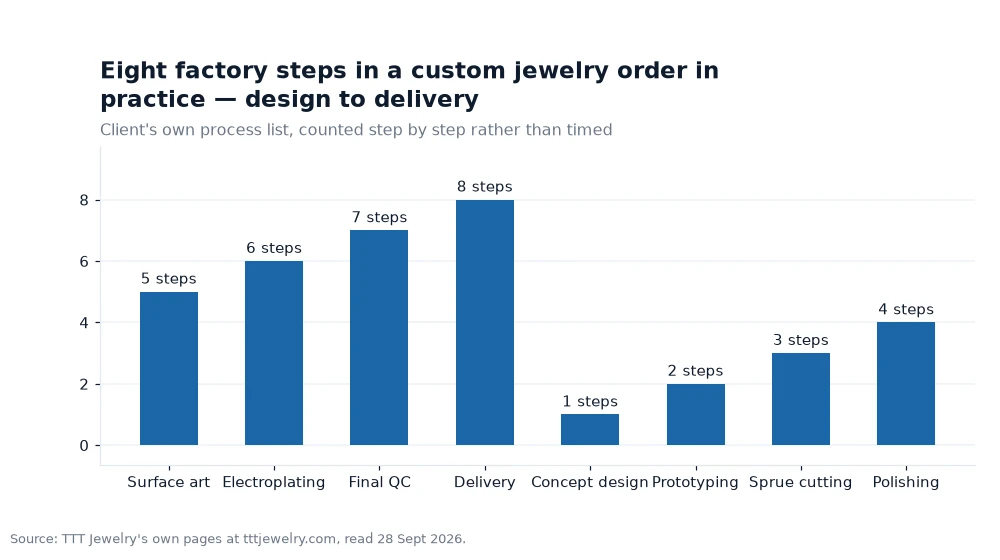
A surface finish is three operations stacked in a fixed order: polishing, then texture, then plating. In the eight-step factory route that TTT Jewelry publishes, those are steps 4, 5 and 6 — 3 of 8 operations, or 37.5% of the documented process. The finish also carries a quantity condition: brass opens at 100 pieces per design, silver at 50.

Key takeaways
- Polish, texture and plate run in that order; cutting texture after plating strips the deposit off the high points.
- Three of the eight published factory steps are surface work, so 37.5% of the route is finish.
- Gold plate, rhodium and PVD are three separate processes, not three shades of one process.
- A 100-piece brass minimum needs twice the units of a 50-piece silver minimum to open the same number of designs.
Three operations, not one
A purchase order that says "gold finish" leaves three decisions open. First, how flat the metal is before anything is applied. Second, whether the surface stays glossy or is broken up with a brushed or textured pattern. Third, what is deposited on top, in how many layers, and with what protective coat.
Each decision answers a different question. Polishing controls how light leaves the metal. Surface art controls how light scatters across it. Plating controls colour, and to a degree wear. A piece can be well polished and badly plated, or evenly plated over a rough surface, and the two faults look nothing alike under a bench lamp.
Because the operations run in sequence, the order cannot be shuffled. Plating is a thin deposit, measured in microns, that follows the shape underneath rather than correcting it. A scratch left after polishing is still there after plating, only shinier. That is why the finish conversation belongs in the sample review, not in the packing hall.
There is also a terminology trap. "Brushed" describes a texture cut into metal. "Matte gold" usually describes a plated surface with a satin additive or a bead-blasted base. The two are produced at different steps and priced differently, so a brief that uses them interchangeably will produce a sample that matches neither description.
Polish first, texture second, plating last
The published route places high-gloss polishing at step 4 and surface art, meaning brushed and textured work, at step 5, with electroplating at step 6. That ordering is the useful detail. Polish establishes the base, the texture is cut into it, and the plating seals both.
Reversing the last two would defeat the purpose. A brushed pattern cut after plating removes deposit from the raised grain, so the piece loses colour exactly where it catches light. A factory offering a brushed gold look therefore brushes the raw metal and plates afterwards, which yields a softer sheen than a mirror polish under the same gold chemistry.
Two-tone work adds a masking stage between polish and plate. The area that stays white has to be covered while the gold area is deposited, then uncovered. Masking is hand work, and hand work is where a two-tone sample most often returns with a soft or wandering boundary between the colours.
Texture also changes how a defect reads. A mirror finish shows every polishing mark; a brushed finish hides small ones and exaggerates deep ones. Buyers who approve a sample in one finish and order in another are effectively approving a different quality standard.
Four plating finishes and one shared constraint
The published plating menu for custom work lists multi-layer 14K, 18K and 24K gold, plus rhodium. Four finishes, one tank process, four different results. Karat changes colour warmth: 14K sits deeper, 24K reads yellow and soft. Rhodium reads white and takes a harder surface, which is why it is used as a final coat as often as a colour in its own right.
Multi-layer means the deposit is built in passes rather than a single dip. Every pass needs preparation, time in the bath and a rinse, so a three-layer stack occupies the electroplating step longer than a single deposit. That is process time rather than material, and process time is the part of plating a buyer can influence without redrawing the piece.
For brands comparing suppliers, the written finish list is a better instrument than a photograph. A jewelry manufacturer for brands that names its karats and its coatings can be held to them on a purchase order. A supplier that quotes "gold tone" has left the specification open, and an open specification is where colour complaints begin.
| Finish | Process | Route step | Typical use |
|---|---|---|---|
| High-gloss polish | Mechanical, multi-stage | Step 4 | Plain metal and chain |
| Brushed or textured | Surface art | Step 5 | Matte contrast, two-tone pieces |
| 14K / 18K / 24K gold | Multi-layer electroplating | Step 6 | Warm gold colour on silver or brass |
| Rhodium | Electroplating | Step 6 | White colour, harder top surface |
| Anti-tarnish e-coat | Barrier coating after plating | Silver and brass lines | Slower colour shift in storage |
| PVD vacuum plating | Vacuum deposition | Stainless steel line | Shower-safe, swim-proof wear |
Because the finish list is written once and repeated across every run, an OEM/ODM jewelry manufacturer normally keeps a plating record per design, with bath chemistry and pass count noted. That record is the document to ask for when a reorder arrives a shade off the approved sample.
Two entries share step 6 because gold and rhodium travel through the same tank process; what differs is the bath and the number of passes. The anti-tarnish coat follows plating and has no numbered step of its own. PVD replaces electroplating on stainless rather than adding to it, which is why a stainless programme and a silver programme cannot be scheduled as if they were the same job.
The two coatings that are not electroplating
Anti-tarnish e-coating is offered on silver and brass. It is a barrier applied after plating to slow the sulphur reaction that darkens silver in storage, in a showcase or in a shipping carton that crosses a warm port. It does not stop tarnish; it delays the visible start of it, and it wears at the same contact points as any other coating.
PVD is the other exception. On stainless steel it is a vacuum deposition rather than an electrolytic one, and the published material note is specific: 316L contains 2–3% molybdenum, is waterproof, and with PVD is shower-safe and swim-proof. 304 stainless is described as water-resistant for daily wear, nickel and lead safe, and vacuum-plated for cost-effective volume.
The distinction is decisive at sampling. A buyer asking for one gold colour across silver, brass and stainless is buying three routes: electrolytic plating on the first two, vacuum deposition on the third. Colour can be matched closely by eye; the process cannot be shared, so the sample schedule cannot be either.
Chemistry sits underneath all of it. Plating is stated as 100% compliant with REACH and CA Prop 65, and the metals are free of lead, cadmium and nickel under REACH. A finish that fails those limits is not usable for a European or US retail buyer, whatever it looks like on a sample card.
Worked example
Take the route as published: eight steps, with surface work at positions 4, 5 and 6. That is 3 ÷ 8 = 0.375, or 37.5% of the documented process devoted to how the piece looks rather than how it is formed. Steps 1 to 3 — concept design, prototyping and sprue cutting — are 3 ÷ 8 = 37.5% as well, and the last two steps, final QC and delivery, take the remaining 25%.
Now apply quantity. Silver opens at 50 pieces per design and brass at 100. For a brand launching four designs, the silver commitment is 4 × 50 = 200 pieces and the brass commitment is 4 × 100 = 400, so the ratio is 400 ÷ 200 = 2. The finish menu is identical on both lines; only the unit count doubles on brass.
Calendar arithmetic explains why finish changes are expensive late. CAD takes under 48 hours, which is 2 days. Sampling runs 25–30 days, or 3.6–4.3 weeks. Production runs 21–28 days. Added together, 2 + 25 + 21 = 48 days at the fast end and 2 + 30 + 28 = 60 days at the slow end, or roughly 7 to 9 weeks. A plating change requested after approval restarts the sampling block, so it lands on top of that total rather than inside it.
Frequently asked questions
Can a piece be plated before it is polished?
It can be, but the deposit then covers polishing marks instead of a clean surface, and the finish reads dull once the piece is handled.
Is a brushed finish cheaper than a mirror polish?
Both sit in the same eight-step route, but brushing adds a texture stage after polishing, so the piece passes through more bench work rather than less.
Does rhodium count as a colour or a protective coat?
It functions as both: it gives a white surface and a harder top layer, and it wears at contact points before it wears elsewhere.
Writing finish into a purchase order
The workable specification names four things per surface: the polish level, the texture direction, the karat or rhodium, and the top coat. Anything left out becomes the factory's choice, and a factory's default is rarely wrong but rarely the same as the buyer's reference sample.
Material choice drives the rest. A plated line in custom brass jewelry starts at 100 pieces per design and carries an anti-tarnish coat as standard practice; a silver line starts at 50 and needs the same barrier for storage. Both accept multi-layer gold, and both are governed by the same REACH limits on lead, cadmium and nickel.
Fixing the finish early also protects the calendar. The sampling block is 25–30 days, and every finish revision goes back through it. A buyer who signs off polish, texture and plate together spends that window once.
Source note: figures come from the manufacturer's own website (tttjewelry.com), read 28 Sept 2026.[1]